
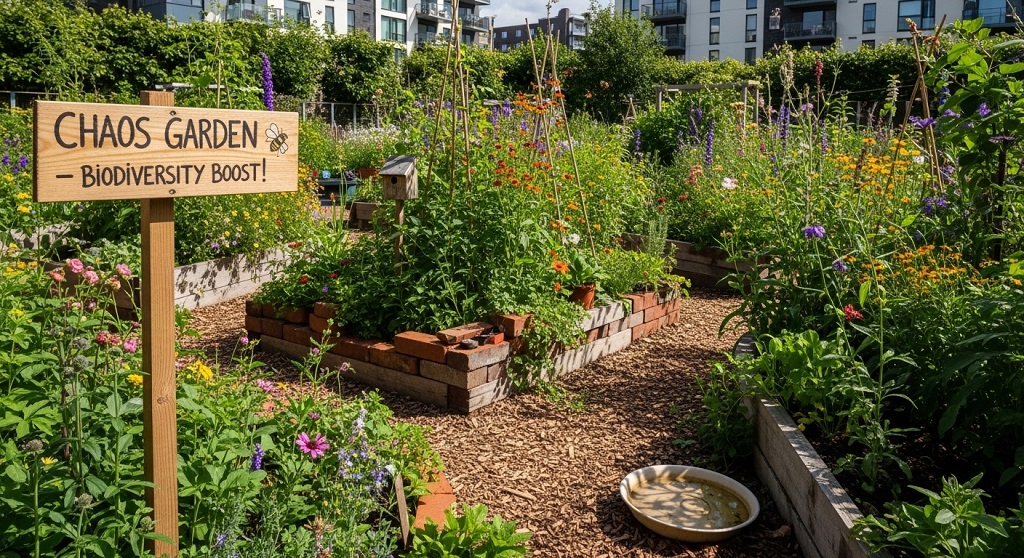
A chaos garden is an intentionally wild, low-maintenance planting space designed to mimic natural ecosystems. Instead of manicured beds and matching borders, you scatter native wildflower seeds, let self-seeders roam freely, and welcome “weeds” that feed pollinators. The result? A thriving patch of land that works with nature rather than against it.
Here’s the problem. Gardens in the UK and US have become increasingly sterile. The Royal Horticultural Society (RHS) reports that ornamental lawns and hard landscaping now cover an estimated 24% of urban green space in Britain — ground that supports almost no insect life. Meanwhile, the UN’s IPBES (Intergovernmental Science-Policy Platform on Biodiversity) confirms that one million species face extinction, many of them the pollinators and ground beetles your local ecosystem depends on.
The chaos garden directly attacks that problem. It converts unused garden corners, neglected verges, and sterile lawns into buzzing, self-sustaining habitats. No expensive plants. No specialist knowledge. Just deliberate “benign neglect” guided by a few simple principles.
This guide walks you through every step — from choosing your site to tracking real biodiversity gains — so you can start transforming your outdoor space this weekend.
What Exactly Does a Chaos Garden Do for Local Biodiversity?
Short answer: It plugs critical gaps in the urban food web by restoring native plant cover that insects, birds, and small mammals depend on.
A 2019 study published in Insect Conservation and Diversity tracked 36 domestic gardens over two growing seasons. Gardens with even a 2 m² patch of native wildflowers recorded 75% more pollinator visits than conventionally planted plots. Bumblebee species richness doubled where knapweed (Centaurea nigra) and bird’s-foot trefoil (Lotus corniculatus) were allowed to self-seed.
The mechanism is straightforward. Native plants co-evolved with local insects over thousands of years. Their flower shapes, bloom timing, and nectar chemistry are precisely matched to local bee and hoverfly species. Exotic ornamentals, however beautiful, often carry no nutritional value for native invertebrates.
Beyond pollinators, a chaos garden builds:
- Leaf litter habitat for ground beetles, centipedes, and hedgehogs
- Bare soil patches for solitary mining bees (35% of UK bee species nest in the ground)
- Standing dead stems where cavity-nesting bees overwinter
- Dense tussock grass that shelters field mice — a primary food source for owls and kestrels
Each of these elements connects to the next. More ground beetles mean fewer slugs. Fewer slugs mean healthier seedlings. Healthier seedlings mean more flowers. More flowers mean more bees. It’s a closed loop — and a chaos garden kickstarts the whole cycle.
How Do You Choose the Right Site for a Chaos Garden?
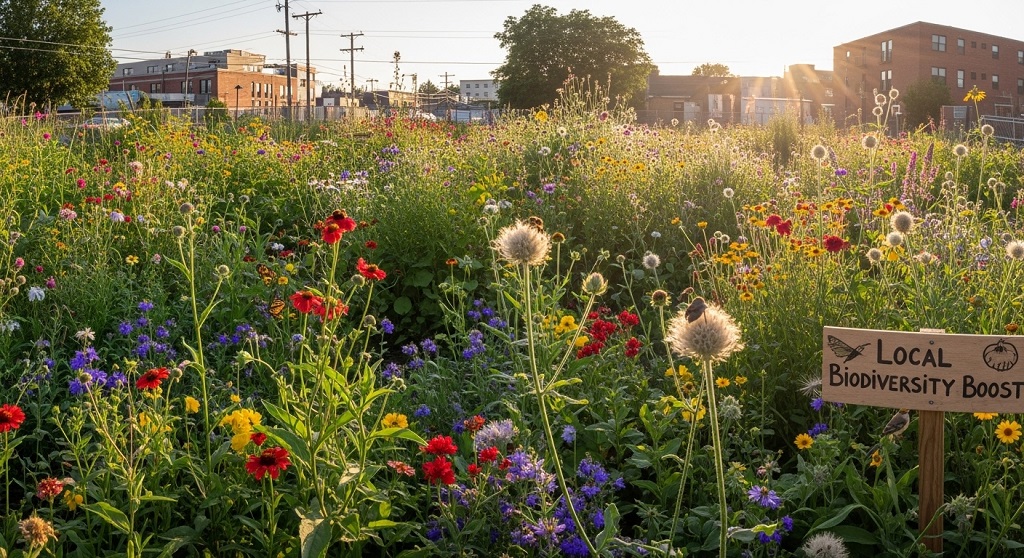
Short answer: Pick the most neglected, lowest-fertility spot you own — poor soil is a feature, not a flaw.
This is where most beginners get it backwards. They prep a rich, well-composted bed and then wonder why nettles and docks take over instead of wildflowers. The reason is simple: wildflowers evolved on poor, nutrient-thin soils. Enrich the ground and fast-growing, nutrient-hungry “thugs” will always outcompete them.
Ideal chaos garden sites:
- A lawn corner that dries out in summer
- A strip along a south- or west-facing fence
- Rubble-filled ground where builders worked
- Thin, chalky or sandy soil that resists regular planting
If your only option is fertile soil, strip the top 5–10 cm of topsoil before sowing. It sounds counterintuitive, but removing fertility is the single most effective step you can take. A case study from the Sheffield Green Surge Project (2021) showed that plots where topsoil was stripped produced 340% more wildflower diversity after two seasons compared to un-stripped controls.
Size doesn’t matter much. The RHS reports measurable biodiversity benefit from plots as small as 1 m², provided the plant species mix is native and varied.
Which Seeds and Plants Should You Use in a Chaos Garden?
Short answer: Prioritise locally-sourced native species. Avoid “wildflower” mixes containing non-natives — they rarely support local insect communities.
Read seed packet small print. Many commercially sold “wildflower” mixes include species from continental Europe or North America that look pretty but deliver minimal ecological value in British or North American gardens. Instead, source seeds from reputable native seed suppliers such as Emorsgate Seeds (UK) or Prairie Moon Nursery (US).
High-Impact Native Plants by Region
| Region | Key Species | Primary Beneficiary |
|---|---|---|
| UK / Northern Europe | Oxeye daisy, Knapweed, Teasel, Yellow rattle, Ragged robin | Bumblebees, hoverflies, goldfinches |
| Eastern North America | Purple coneflower, Black-eyed Susan, Wild bergamot, Ironweed | Monarch butterflies, native bees, ruby-throated hummingbirds |
| Western North America | California poppy, Clarkia, Gumweed, Yarrow | Mason bees, painted lady butterflies, Anna’s hummingbirds |
| Australia | Billy buttons, Native daisies, Kangaroo grass, Grevillea | Blue-banded bees, honeyeaters, micro-bats |
One non-obvious tip: include Yellow rattle (Rhinanthus minor) if you’re converting a lawn in the UK. It’s a hemi-parasitic annual that weakens grass by tapping its root system, cutting grass vigour by up to 60% and opening the sward for wildflowers to colonise — no digging required.
When Is the Best Time to Start a Chaos Garden?
Short answer: Autumn is optimal for most temperate regions. The cold stratification period over winter breaks seed dormancy and produces stronger spring germination.
A common mistake is buying seeds in spring excitement and scattering them in April. Many native wildflower seeds — particularly those in the carrot and daisy families — require a cold period of 6–12 weeks to germinate reliably. Autumn sowing gives seeds this naturally.
That said, a basic “scatter-and-observe” approach works year-round:
- Autumn (Sept–Nov): Best for perennials and annuals needing cold stratification. Ideal for Yellow rattle.
- Late winter (Feb–Mar): Surface-sow onto bare soil. Light frost can still aid germination.
- Spring (Apr–May): Works for fast-germinating annuals like poppies, cornflowers, and phacelia. Manage competing weed growth carefully.
One practical method: green hay spreading. Source freshly cut hay from a local wildflower meadow in July or August, spread it directly onto your prepared site, and leave it. As it dries, seeds drop into the soil. This transfers an entire local seed bank — including grasses, forbs, and legumes — in one step. The People’s Trust for Endangered Species (PTES) has documented this technique successfully restoring meadow plant communities within three growing seasons.
How Do You Manage a Chaos Garden Without Killing the Biodiversity?
Short answer: Cut once a year in late autumn, remove the cuttings, and do almost nothing else.
The management paradox is real: if you do too little, rank grasses and nettles take over. If you do too much, you destroy the very structure insects depend on. The sweet spot is one annual cut, timed correctly.
The correct timing: late October to early November in temperate zones. By then:
- Teasel and knapweed seeds have dispersed
- Overwintering insects have settled into stems and leaf litter
- Birds have finished feeding on seed heads
Always remove cuttings from the site. Leaving them accelerates soil fertility and undermines the low-nutrient conditions your wildflowers need. Compost the cuttings or use them as hedge-bottom mulch.
Leave 5–10% of stems standing through winter. Research from the University of Sussex found that hollow stems of plants like teasel, hogweed, and bramble shelter over 40 species of solitary bee and wasp through winter months. Cutting everything flush with the ground eliminates an entire dimension of habitat.
Beyond the annual cut, resist the urge to weed. What looks like a “weed” is often a critical food plant. Common nettles support the caterpillars of small tortoiseshell, peacock, red admiral, and comma butterflies. Dandelions provide the first pollen of the year for early-emerging bumblebee queens. Dock leaves host the larvae of several specialist moth species.
How Can You Measure the Biodiversity Impact of Your Chaos Garden?
Short answer: Use free citizen science apps to log species visits — the data is genuinely useful to conservation researchers.
Tracking your results keeps you motivated and contributes to national biodiversity databases. Three free tools worth using:
- iNaturalist — photograph any organism, AI identifies it, data feeds into global research databases
- UK Butterfly Monitoring Scheme app — 5-minute transect walk, records butterfly species and counts
- BeeWalk app (BWARS) — records bumblebee species on a set monthly route through your garden
Set a baseline in year one. Walk your chaos garden plot for 10 minutes once a week from April to September. Note every insect, bird, and mammal species observed. By year two, most gardeners report three to five times the species count compared to a conventional lawn — not as an estimate, but as logged iNaturalist records.
For a real-world benchmark: the RHS Plants for Bugs study (2011–2016) monitored 36 volunteer gardens across the UK over four years. Plots converted to native wildflowers recorded an average of 2.2 times more invertebrate abundance and 1.8 times greater species richness than ornamental plots within two growing seasons.
Ready to Grow Wild? Here’s Your Next Step
The evidence is solid. Native wildflower plantings measurably increase pollinator abundance, support insect food webs, and restore habitat connectivity in fragmented urban landscapes — often within a single growing season. A 2 m² patch of knapweed and oxeye daisy outperforms a 20 m² ornamental border on every ecological measure that counts.
The chaos garden is not about abandoning beauty. Wild plants in flower are genuinely striking. A teasel in seed catches winter light like a sculpture. A patch of ragged robin in June stops people in the street.
Start this weekend. Strip a metre of turf. Scatter a native seed mix. Put your mower away. Then watch what shows up.
Ready to take action? Download a free native seed guide for your region, share your chaos garden progress using #ChaosGarden on social media, and log your species sightings on iNaturalist to contribute to real conservation science. Your garden is data. Use it.
Frequently Asked Questions About Chaos Gardens
Is a chaos garden the same as a wildflower meadow?
Not exactly. A wildflower meadow typically covers a larger area and follows a specific management regime — usually two cuts per year — to maintain grass-forb balance. A chaos garden is smaller, more diverse in structure (including shrubs, dead wood, and bare soil), and managed even less intensively. Think of a chaos garden as a wildflower meadow plus additional habitat layers: log piles, tussock grass, and standing dead stems. Both serve biodiversity goals, but a chaos garden is more accessible for typical domestic plots.
Will a chaos garden attract rats or pests?
This concern comes up often and is largely unfounded in practice. Rats are attracted to food waste, compost bins, and bird feeders — not to vegetation. Dense plant cover does provide shelter for field mice and voles, which are part of a healthy ecosystem and prey for owls and foxes. If rats are already present on your property, the issue will be a food source, not your wildflower patch. Remove attractants (unsecured bins, pet food) first.
Can I start a chaos garden in a small urban garden or balcony?
Yes. Container chaos gardens work well on balconies and small patios. Use deep pots (minimum 30 cm depth) filled with low-fertility growing medium — mix standard compost with 50% horticultural sand or grit. Sow native annuals like phacelia, pot marigold (if native to your region), and wild marjoram. A University of Bristol study found that even balcony containers planted with native flowers received regular visits from bumblebees and hoverflies in urban areas, demonstrating measurable connectivity within city pollinator networks.
How long does it take a chaos garden to establish?
Expect a realistic timeline of two to three years for full establishment. Year one is typically dominated by annual pioneer species — poppies, cornflowers, and phacelia. Year two sees perennials begin to flower. By year three, the plant community self-organises and biodiversity metrics (species richness, invertebrate abundance) peak. Autumn-sown plots consistently establish faster than spring-sown ones due to natural cold stratification. Patience is the primary skill required.
Do I need planning permission to create a chaos garden?
In most jurisdictions, no planning permission is required for garden planting changes on private land. However, if you’re converting a front garden and live in the UK, be aware of local authority guidelines on front garden surfaces (which mainly target hard paving and drainage). Converting a lawn to wildflowers is universally permitted and actively encouraged by councils under biodiversity net gain frameworks introduced in the Environment Act 2021. Check with your local authority if your property is listed or within a conservation area.
What is “yellow rattle” and why is it recommended for chaos gardens?
Yellow rattle (Rhinanthus minor) is a native annual wildflower and hemi-parasite. It attaches its roots to nearby grass roots and extracts water and nutrients, weakening grass vigour without killing it. This reduces the competitive dominance of coarse grasses and opens up gaps in the sward where fine-leaved wildflowers can germinate. Research shows yellow rattle can reduce grass biomass by 30–60% within two seasons, making it one of the most cost-effective tools for lawn-to-meadow conversion. It must be sown fresh in autumn — stored seed loses viability rapidly.
Which common garden “weeds” should I keep for biodiversity?
Several common weeds deliver outsized ecological value. Common nettle (Urtica dioica) is the larval food plant for four of the UK’s most colourful butterflies. Dandelion (Taraxacum officinale) provides critical early-season pollen for bumblebee queens emerging in March. Creeping thistle (Cirsium arvense) feeds painted lady and red admiral caterpillars and produces seeds eaten by goldfinches and linnets. Bramble (Rubus fruticosus) flowers feed over 20 bee species and produces fruit for blackbirds, dormice, and foxes. Leave a managed patch of each and you’ve effectively built a wildlife corridor at no cost.
Related Topics: How to Increase Flowering in Plants Naturally
What Next: How to Prepare Soil for Spring Planting (Expert Guide)