
Palisade Fencing Types and Their Uses
While many types of palisade fencing look similar, not all are equal. The pale shape, the fence profile, the finish to the pale and the type of gate used all vary for different uses. Here we look at the main types and describe where each might be used.
W-Section and D-Section Pales
W-section pales are stronger than D-section pales for the same height, due to their W-shaped profile when viewed from above. This means they are more rigid for their weight than D-section pales and therefore more suitable for standard security fencing of a boundary. D-section pales on the other hand are more resistant to bending than W-section pales and therefore are sometimes worth the extra cost for sites where there is valuable plant or equipment stored within a compound.
Bow-Top Fencing for Lower Risk Sites
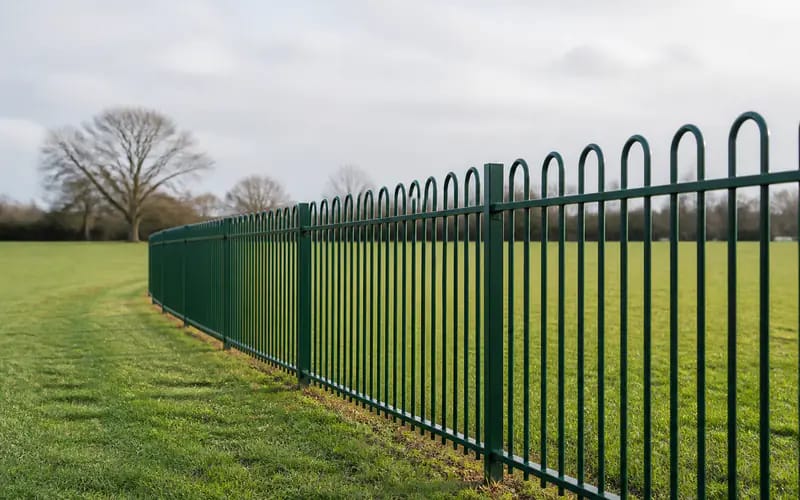
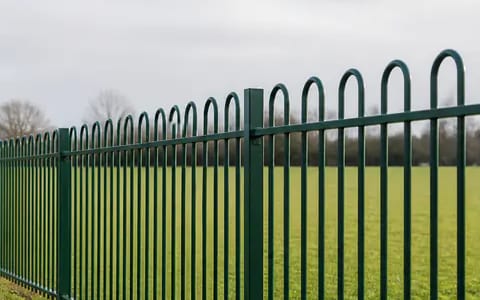
A Bow-top (or Round-top) fence has curved pales on the top of the fence. A popular choice for schools, parks and playing fields as the rounded pales at the top of the fence remove any obvious points which could cause injury. However, the fence will not offer any security against determined intruders and is therefore suitable for sites where the primary function is to define boundaries for young children to play within.
Pointed Pales for Higher Security Perimeters
For higher risk sites pointed pales can be supplied as single point or as more secure triple point pales. These types of fence are typically used around sites such as utility depots, sub-stations and water treatment works etc. Again security fence products are typically tested to recognised security standards and it is wise to check that a proposed fence has been put through the relevant security tests to ensure it actually does perform as expected.
Timber Palisade Fencing
As a general rule steel fence is stronger than timber fence. However timber fencing can be a cost effective alternative for marking boundaries around gardens, rural gardens, agricultural land, farms, woodlands, forestry, golf courses, parks and open spaces. As it is made of softwood it can be pointed at the top or have a simple chamfer. As with all palisade fencing of any type occasional treatment will be required and every now and then a pale will need to be replaced but for general boundary marking it does the job.
Euro-Rail and K-Rail Panel Systems
There are a number of different types of palisade fencing that are joined together by steel railings to form panel enclosures. Euro-rail and K-rail are two examples of such fencing that are typically used for long boundary runs around sites such as railway lines, motorways and large utility enclosures. These types of fence are normally installed as pre-formed panel sections which are bolted together on site and then secured to posts. Because of their panel formation they are not as versatile as individually fixed pale fencing and are generally restricted to long straight runs and gentle curves, failing on very tight boundary changes.
Galvanised and Powder-Coated Finishes
Galvanising the steel of a fence in a layer of zinc gives a tough, abrasion-resistant coating which can be left to form a layer of patina to protect the fence from further attack. Such a finish is particularly suitable for exposed sites, coastal locations and sites which are affected by industrial pollution. However, when a more aesthetic finish is required, fences can be powder coated in a wide range of colours including black, green and brown. It is not uncommon for a fence to be galvanised first and then powder coated to give a higher corrosion protection and a coloured finish. However, for fences situated in exposed locations such as near the coast, the galvanizing is the most important layer.
Matching Gates to the Fence Type
A gate needs to match the fence it is attached to. A bow-top fence is often paired with single pedestrian gates, with pointed pale security fences being complemented by both single and double gates for vehicle access. Cantilever sliding gates, sliding along the ground on a track, can also be of use in very high traffic industrial sites where gates are subject to frequent opening and closing, or where the ground may from time to time flood or freeze.
Matching the Fence to the Actual Risk
There is often a temptation to go for the highest, most heavy-duty and most expensive security fence available but this is not always the most suitable option. Schools need protecting from children accidentally walking through the fence but substation sites need protecting from intent to steal and possible sabotage. Working out the level of risk for any proposed fence location and then selecting a suitable profile, height and finish will help to avoid over specifying a particular perimeter and thus incurring unnecessary cost and under specifying and thus putting people at risk. The best security fence for any site is one that matches the site.