
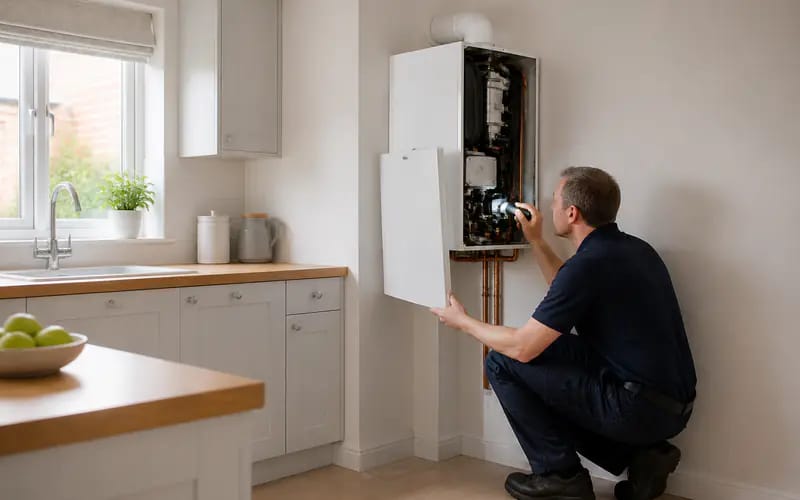
It helps to know what happens during a service visit and how long it might take for a proper service to be carried out on your boiler. Often people have no idea what to expect during a service visit and therefore can be mistaken into thinking the engineer has only been to put a new seal on the boiler.
The Usual Time Window
On average a boiler service will last around 45 minutes to an hour. Most boiler services are completed within a reasonable time frame providing access to the boiler is straightforward and it has been previously serviced on a yearly basis.
Visual and Safety Checks First
The first portion of the service will involve a visual inspection of the boiler and surrounding areas. The casing and seals will be inspected for any signs of damage. The engineer will also look for any signs of staining or corrosion that could indicate a leak. The flue will also be checked to ensure it is properly connected and not blocked. In addition, the engineer will check the ventilation around the boiler to ensure that it is working correctly and pulling in and out the correct amount of air.
Gas Pressure and Burner Performance
The engineer will check the gas pressure into the boiler and test the burner. The pressure needs to be within the manufacturers recommended parameters, and the burner needs to be operating correctly. He will also look at the flame produced by the burner and check for correct operation. An uneven or discoloured flame can indicate a problem with combustion.
Flue Gas Analysis Readings
Flue gas analysis readings from a flue gas analyzer (such as a displayed data logger) are taken to check the boiler’s efficiency and the amount of carbon monoxide being produced. The readings are usually displayed on the analyzer, and should be recorded by the engineer for future reference. Any engineer worth their salt will be able to explain the readings for your specific boiler, and why they are within acceptable limits.
Testing the Safety Devices
A typical gas fired boiler contains several safety devices which will be checked during a service, such as the boiler’s thermostat to ensure it’s functioning correctly. The pressure relief valve will also be tested to ensure it will function as designed and relieve any excess pressure in the event of the system becoming over heated or over pressurized. See also Boiler Service Cheltenham.
What Can Make It Take Longer
These services can take longer than an hour depending on a number of factors. For example, if the boiler is tucked away in a loft, or awkwardly located within a cupboard, it can take longer to access and work on than a boiler that is located within easy reach on a kitchen wall. An older boiler will also take longer to service as there is more potential for scale and wear to check. It’s also worth noting that a first-time service on a boiler that has never been serviced properly before will take longer than a service on a boiler that has been regularly serviced before. Finally, combi boilers have a few more components than system boilers (such as the diverter valve) that need checking during a service.
When Working On a Boiler in Cheltenham
Local housing in Cheltenham is diverse. Many older properties in Cheltenham’s town centre are of terraced construction whereas the outskirts of town are home to many new homes, including some large complexes.
Why Too Quick Can Be a Red Flag
If an engineer is on a job within fifteen to twenty minutes then it is worth finding out what they have been doing for that time. A service may appear to have been completed but if the flue gas analysis has not been carried out or the pressure relief valve has not been tested then it has not been a full service. The time taken for a Gas Safe registered engineer to complete the required checks to service a boiler will vary but most take around an hour to service a boiler fully and methodically.
What Happens at the End
After the engineer has finished his/her checks, s/he will complete a service record either in writing or by computer. This is a very important document which will outline the various checks that the engineer has completed and the results of any tests carried out (e.g. flue gas analysis). It is a good idea to ask the engineer to retain a copy of the service record and to inform you of any parts that need to be replaced or any settings that need to be amended. The engineer should also explain in detail any recommendations that he/she may have for future works.
By knowing what to expect during a boiler service, it will allow you to ask further questions and get a better understanding of your boiler’s health throughout the year.