
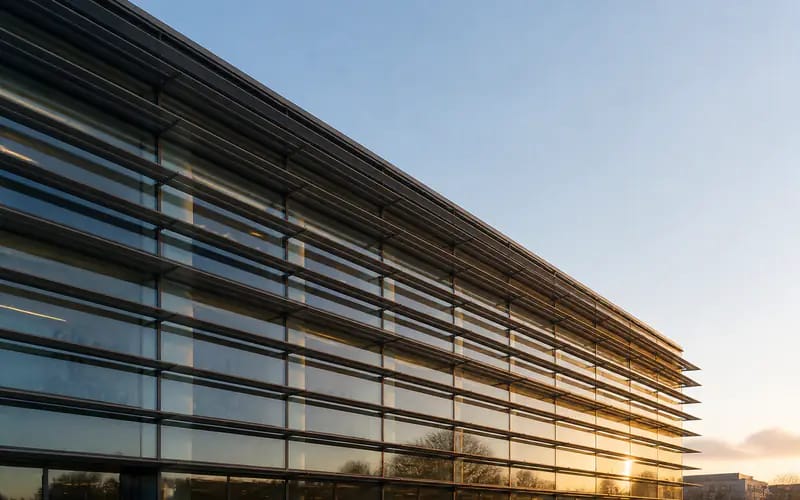
A sunshade which is excellent in summer can be completely the wrong solution for the winter months. Solar shading needs to be considered in the same depth as the seasonal change of the sun’s position over the year.
Why The Sun’s Angle Changes So Much
The sun’s position in the sky varies throughout the year and, more significantly, throughout the day. In summer, the sun is high in the sky by midday, whereas in winter it is much lower even at noon. For horizontal fins, high-angle sun is easily deflected while low-angle sun penetrates between the faces of the fins. The performance of a shading system in terms of solar gain control therefore varies markedly from season to season.
Fixed Fins Mean A Compromise
While a fixed-angle Brise Soleil will function adequately in both summer and winter, there will be some compromise in its performance. For example, a setting that will prevent summer glare also may stop low-level winter sun from entering a room and thus increase heating demands at the worst time of the year. Conversely, a setting that allows low-level winter sun to enter will cause overheating in the summer months. There is no single angle that will perform adequately in both seasons.
Adjustable Louvres Cover Both Seasons
An adjustable or motorised louvre is able to change the angle of the fins throughout the year. This allows them to be angled up to horizontal in summer to block high summer sun, and then to be lowered to be as flat as possible and even opened up in winter to allow low winter sun into the building. A simple manual adjuster, in the form of a lever or crank, is suitable for small to medium sized domestic or single-storey non-domestic properties. However, larger commercial properties are more commonly fitted with a motorised system, sometimes with sensors fitted to allow automatic control by the sun.
Orientation Changes Everything
Brise soleil on south-facing walls are generally the easiest to size as the sun’s seasonal change in angle is quite predictable. East- and west-facing walls are more difficult to size as they receive low-angle sun not only in winter but also during summer’s early morning and late evening sun. Designs sized to combat summer’s worst glare and discomfort would result in fins that are too deep and close together and as a result block far too much useful free heat in winter. It is essential that a balanced design is created that takes into account both ends of the season, rather than simply the one that has caused most discomfort.
The Risk Of Sizing For Summer Only
It’s an easy mistake to assume that the worst day of summer glare is the worst that will happen and design around that single occasion. In reality, the fins will likely be too deep or too close together to allow any useful amount of winter sun to enter the building and heat it up naturally. All that free heat will be lost and the building will have to be heated by other means.
Checks Worth Running Before Fitting One
When thinking about solar shading it is worth plotting out the sun’s path for the building’s latitude at midsummer and midwinter to understand the angle of the sun at these times. A sun-path diagram or simple shadow study could include measurements at midday as well as a couple of other times during the day. Published guidance on managing solar gain in buildings for UK latitudes outlines typical angles and the building’s seasonal behaviour. These points should be checked before fixed or adjustable elements are set to a particular fin depth and spacing to prevent costly errors later.
Working Alongside Blinds And Glazing
A well designed Brise Soleil works best as part of a wider approach to solar control. Even with the best design for fixed or adjustable solar shading, there will be occasions, particularly on sides of a building with a complex solar path throughout the day, where additional measures will be required to manage solar gain. For example, a low sun in winter or a very bright low sun in spring. Internal blinds or facilities to operate existing blinds will provide additional control of solar gain through the buildings’ windows. Solar control glazing to the buildings’ windows can also reduce solar gain passing through the glass of the building.
For Brise Soleil, visit Aluminium Systems.
Getting The Balance Right
However, there is no ‘one size fits all’ answer for fixed solar shading as it will depend upon the latitude of the building, the orientation of the facade and the user’s requirements between having heat from low sun angle in the winter and keeping out discomfort from high sun angle in the summer. Proper consideration should be given to the seasonal sun angle position over the year and not simply relying on a designer’s best guess for the worst summer day.